42 Amazing Sparrow Facts: Science, Nature & Fun Trivia
Sparrows represent a critical group of avian species within the family Passeridae, serving as vital bio-indicators for environmental health across urban and wild ecosystems. These small, granivorous birds have undergone significant evolutionary adaptations that allow them to coexist with human populations on every continent except Antarctica. Their biological success is tied to specialized skeletal structures and highly efficient metabolic rates that support survival in diverse climates.
The following report categorizes these birds into Old World and New World classifications, detailing their unique physiological traits and social hierarchies. This analysis provides a comprehensive breakdown of 42 specific facts regarding their taxonomy, dietary requirements, reproductive cycles, and the latest scientific data on their survival mechanisms.
The Science of Sparrows: Taxonomy and Biology
When scientists look at a sparrow, they see a masterpiece of evolutionary engineering. These birds are built for high-energy living. Everything from their skeletal structure to their respiratory system is designed to keep them light and fast. While they might look like simple brown birds, their biology allows them to survive in climates ranging from freezing mountain peaks to hot, humid tropical islands.
- Sparrows belong to the family Passeridae.
- There are about 28 different species classified as true sparrows.
- The House Sparrow is scientifically known as Passer domesticus.
- They are split into Old World sparrows and New World sparrows based on their evolutionary history.
- The average sparrow is only 5 to 7 inches long.
- A typical adult weighs between 24 and 40 grams, which is about the same as a few slices of bread.
- Their beaks are cone-shaped, allowing them to exert massive pressure to crack hard seeds.
- A sparrow has 14 neck vertebrae, giving them more neck flexibility than a giraffe.
Where They Live and How They Travel
Sparrows are world travelers, but they are also very loyal to their homes. They have successfully hitched rides on ships and moved across oceans to settle in new lands. Unlike some birds that migrate thousands of miles every year, many sparrow species prefer to stay close to where they were born, becoming experts on their specific neighborhood.
- Sparrows are found on every continent except Antarctica.
- They are known as urban dwellers because they actively seek out human settlements.
- Many sparrows spend their entire lives within a 1.5-mile radius.
- They move on the ground by hopping because their leg muscles are designed for spring-like movements.
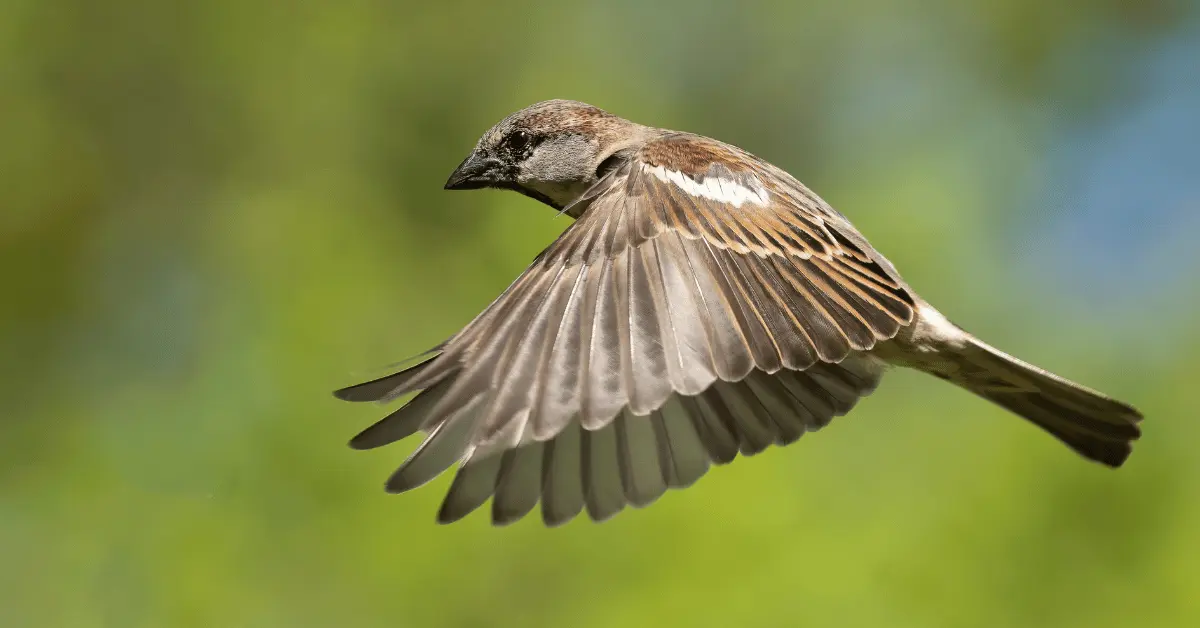
- They can reach flight speeds of 30 miles per hour when escaping a predator.
- They avoid dense jungles because they prefer open spaces where they can see danger coming.
What Do Sparrows Eat?
The diet of a sparrow is much more diverse than most people think. While they are famous for visiting bird feeders, they are actually very clever hunters when they need to be. Their ability to switch from eating seeds to eating insects is one of the main reasons they have survived for so long in changing environments.
- Sparrows are omnivores, meaning they eat both plant-based food and small animals.
- Their primary food source in nature consists of wild grass seeds and grains.
- In city environments, they have learned to digest processed foods like bread and rice.
- During the spring, they focus on catching caterpillars and beetles to feed their chicks.
- They swallow tiny bits of stone and sand to help their stomach grind up hard seeds.
- They are known to steal food from larger birds by using their speed and agility.
Social Behavior and Secret Habits
Watching a flock of sparrows is like watching a tiny, busy community. They have a strict social hierarchy and communicate constantly using a variety of chirps and body movements. They are also very concerned with hygiene and have developed unique ways to keep their feathers in perfect condition.
- They are highly social and almost always live in groups called flocks.
- Sparrows take dust baths by flipping dry soil over their feathers to kill parasites.
- They also engage in social washing, where many birds bathe in water at the same time.
- Their chirps can signal everything from a food find to a nearby hawk.
- Male sparrows have a black bib on their throat that acts as a badge of rank.
- The larger and darker the black bib, the more respect the male gets from the flock.
- Females have duller feathers to blend into the nest and hide from predators.
- They are known to roost together in large numbers during winter to share body heat.
Nesting and Family Life
Sparrows are some of the most creative builders in the bird world. They do not just stick to trees; they will use almost any sturdy structure to protect their young. Their family life is busy and fast-paced, as they try to raise as many chicks as possible during the warm months.
- Most sparrows are monogamous and work as a team with their partner.
- The male usually finds a location first and chirps loudly to claim it.
- They build nests in roof eaves, wall holes, and even inside street lights.
- A female can lay up to 5 eggs in a single clutch.
- The eggs are greenish-white with brown spots for camouflage.
- The incubation period is very short, lasting only 10 to 14 days.
- Both the mother and father take turns keeping the eggs warm.
- Chicks grow so fast that they can fly and leave the nest in about 15 days.
Surprising and New Facts
New research is constantly revealing how smart these birds really are. From their memory skills to their physical abilities, sparrows continue to surprise scientists. They are much more than just a common garden bird; they are highly intelligent creatures that have learned to master the human world.
- Sparrows are capable of swimming short distances if they fall into water or are hunted.
- A sparrow’s heart beats over 400 times per minute while it is active.
- Studies have proven that sparrows can recognize individual human faces and remember who is friendly.
- In some cities, sparrows have learned to hover in front of motion-sensor doors to get into shops.
- World Sparrow Day is celebrated every March 20th to help protect them.
- Because they are sensitive to air quality, they act as a bio-indicator for environmental health.
Conclusion
Sparrows are incredible survivors. From their high heart rates to their ability to recognize faces and open doors, they are much more than just common birds. They play a vital role in our ecosystem by controlling pests and spreading seeds. By understanding these 42 facts about sparrow life, we can see why it is so important to protect their habitats.